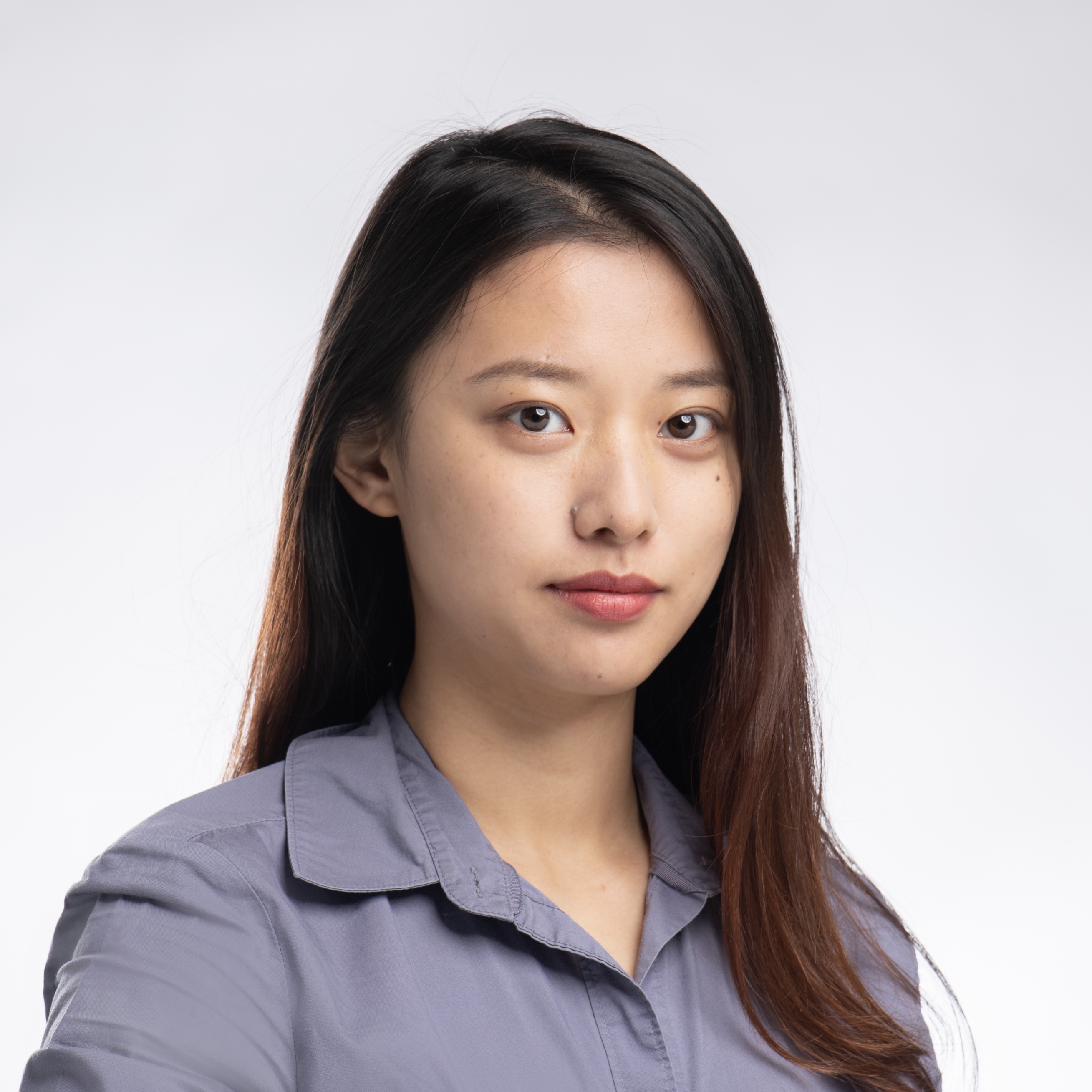
About Me
I am a Lecturer in the Department of Mechanical Engineering at University College London and the founder of LUMA Lab, where we explore generative modelling, multi-agent reasoning, and data-centric methods for personalised and interpretable healthcare. Visit LUMA Lab to learn more about our research. I am also a Visiting Researcher at The Alan Turing Institute and at FAU Erlangen-Nürnberg.
Before joining UCL, I was a Research Associate jointly appointed at the Data Science Institute and the Department of Brain Sciences at Imperial College London. My research lies at the intersection of generative AI and medical imaging, with a focus on deep generative models for cardiac diagnostics and digital twins for personalised health.
I completed my DPhil at Fudan University, in a joint programme with Imperial College London, where my thesis on breast cancer diagnostics received top honours.
I have received several awards and fellowships, including the Imperial College Research Fellowship (declined upon accepting my UCL Lectureship), the Dame Julia Higgins Fund (as both PI and Co-PI), the DAAD Postdoc-NeT-AI Scholarship, and the UCL–Fudan Strategic Partner Fund (as PI). I serve as an Area Chair for MICCAI 2026.
My research interests include medical image analysis, generative modelling, and clinically grounded machine learning. I have published over 30 papers in venues such as Nature Machine Intelligence, Nature Cardiovascular Research, IEEE TMI, and MICCAI. You can find my publications on Google Scholar.
News
- 2026.10 Invited speaker at Fudan University
- 2026.07 Invited keynote at the AIBE Conference 2026, FAU Erlangen-Nürnberg: From Personalised Cardiac Digital Twins to Agentic Clinical Discovery
- 2026.07 Awarded the UCL–Fudan Strategic Partner Fund 2026/27 as PI
- 2026.06 🎉 CPAgents is accepted by MICCAI 2026
- 2026.06 Keynote speaker at the Oxford Computer Science Conference with OxWoCS, University of Oxford
- 2026.06 Started a DAAD Postdoc-NeT-AI research stay at FAU Erlangen-Nürnberg (Jun–Sep 2026)
- 2026.06 Keynote at BAIOSPHERE Medical 2026, FAU Erlangen-Nürnberg
- 2026 Serving as Area Chair for MICCAI 2026 and co-organising the 2nd Agentic AI for Medicine (AgenticMed) Workshop at MICCAI 2026
- 2025.10 Invited lecture at Shenzhen University: Medical Foundation Models and Generalist AI for Healthcare
Earlier news
- 2025.08 Joined UCL Mechanical Engineering as a Lecturer and founded LUMA Lab
- 2025.06 🎉 Three papers are early accepted by MICCAI 2025
- 2025.03 Invited as a Visiting Researcher at Alan Turing Institute
- 2025.05 MeshHeart featured in Imperial College London news
- 2025.03 🎉 One paper is accepted by Nature Machine Intelligence
- 2024.12 Awarded Imperial College Research Fellowship
- 2024.11 Selected as a speaker for TEDxRutlish
 on December 19th, 2024.
 - 2024.10 Selected as a DAAD AInet Fellow for the Postdoc-NeT-AI 11/2024 Virtual Networking Week on AI for Science
- 2024.10 Invited talk at Fudan University
- 2024.10 Received funding as PI from the Dame Julia Higgins Fund
- 2024.10 Received funding as Co-PI from the Dame Julia Higgins Fund
- 2024.09 One paper is released at arxiv
- 2024.09 🎉 One paper is accepted by Nature Cardiovascular Research
- 2022.10 Joined BioMedIA
 , Imperial College London as a research associate in UK!
Publications
For a full list, please see my Google Scholar. * denotes equal contribution.
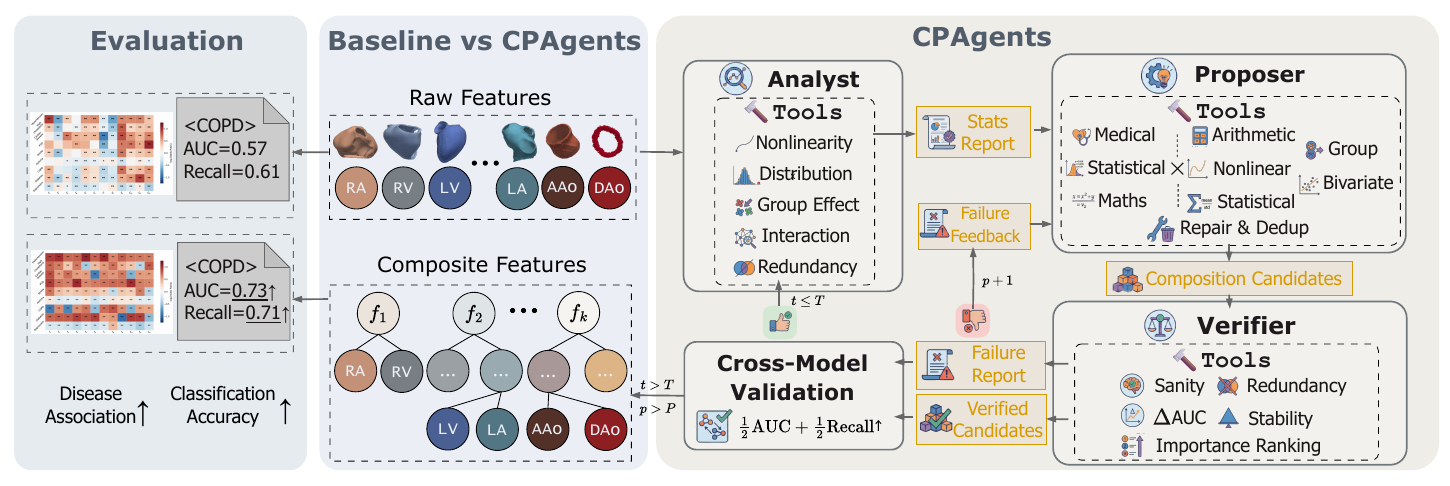
CPAgents: Agentic Composite Phenotype Generation for Cardiac Disease Association
Zuoou Li*, Wenlong Zhao*, Kelly Yu*, Weitong Zhang, Paul M. Matthews, Wenjia Bai, Bernhard Kainz, Mengyun Qiao
MICCAI 2026
- An analyse–propose–verify loop of specialised agents (Analyst, Proposer, Verifier) builds interpretable composite cardiac phenotypes.
- Composite phenotypes strengthen disease association and classification over raw imaging features.
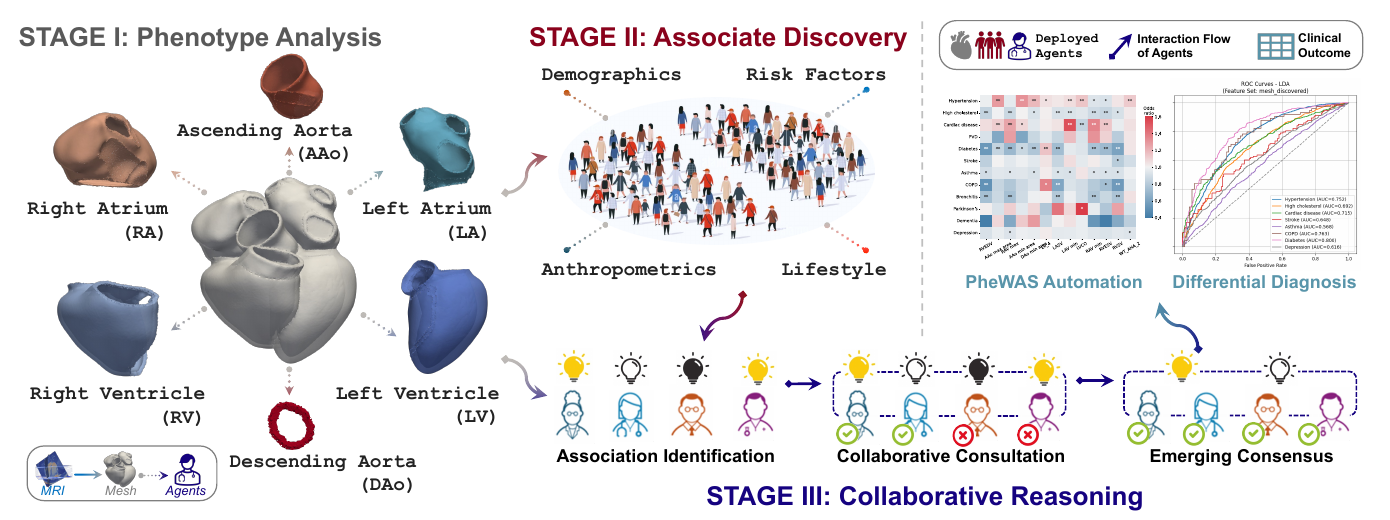
Multi-Agent Reasoning for Cardiovascular Imaging Phenotype Analysis
Weitong Zhang*, Mengyun Qiao*, Chengqi Zang, Steven Niederer, Paul M. Matthews, Wenjia Bai, Bernhard Kainz
MICCAI 2025
- MESHAgents: the first multi-agent system for imaging phenome-wide association studies, where domain-specialist LLM agents reach consensus on phenotype–factor associations.
- Agent-discovered phenotypes match expert-selected ones in diagnostic performance across 38,309 UK Biobank participants.
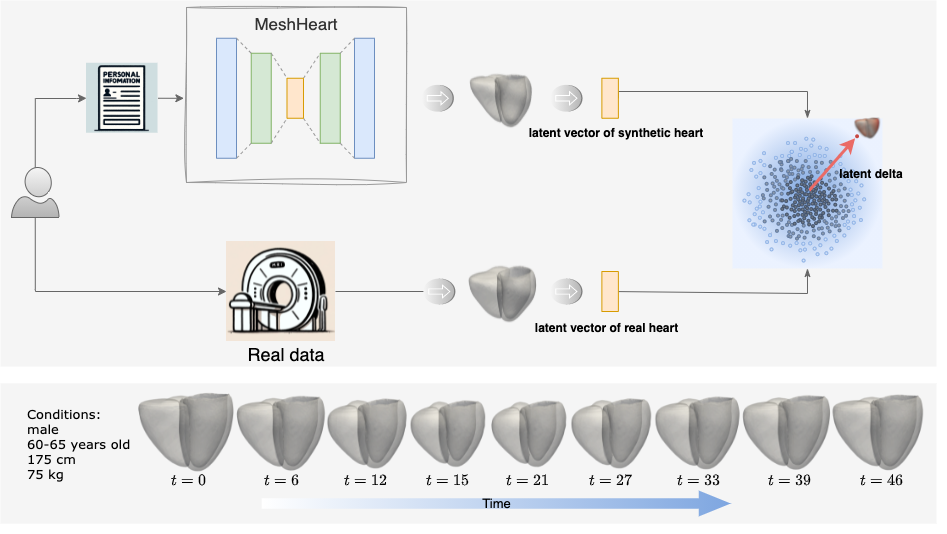
A personalized time-resolved 3D mesh generative model for unveiling normal heart dynamics
Mengyun Qiao, Kathryn A McGurk, Shuo Wang, Paul M. Matthews, Declan P O’Regan, Wenjia Bai
Nature Machine Intelligence 7, 800–811 (2025) | Imperial News
- Developed a novel 4D mesh generative model for personalized cardiac anatomy reconstruction.
- Demonstrated improved accuracy in representing normal heart dynamics compared to baseline models.
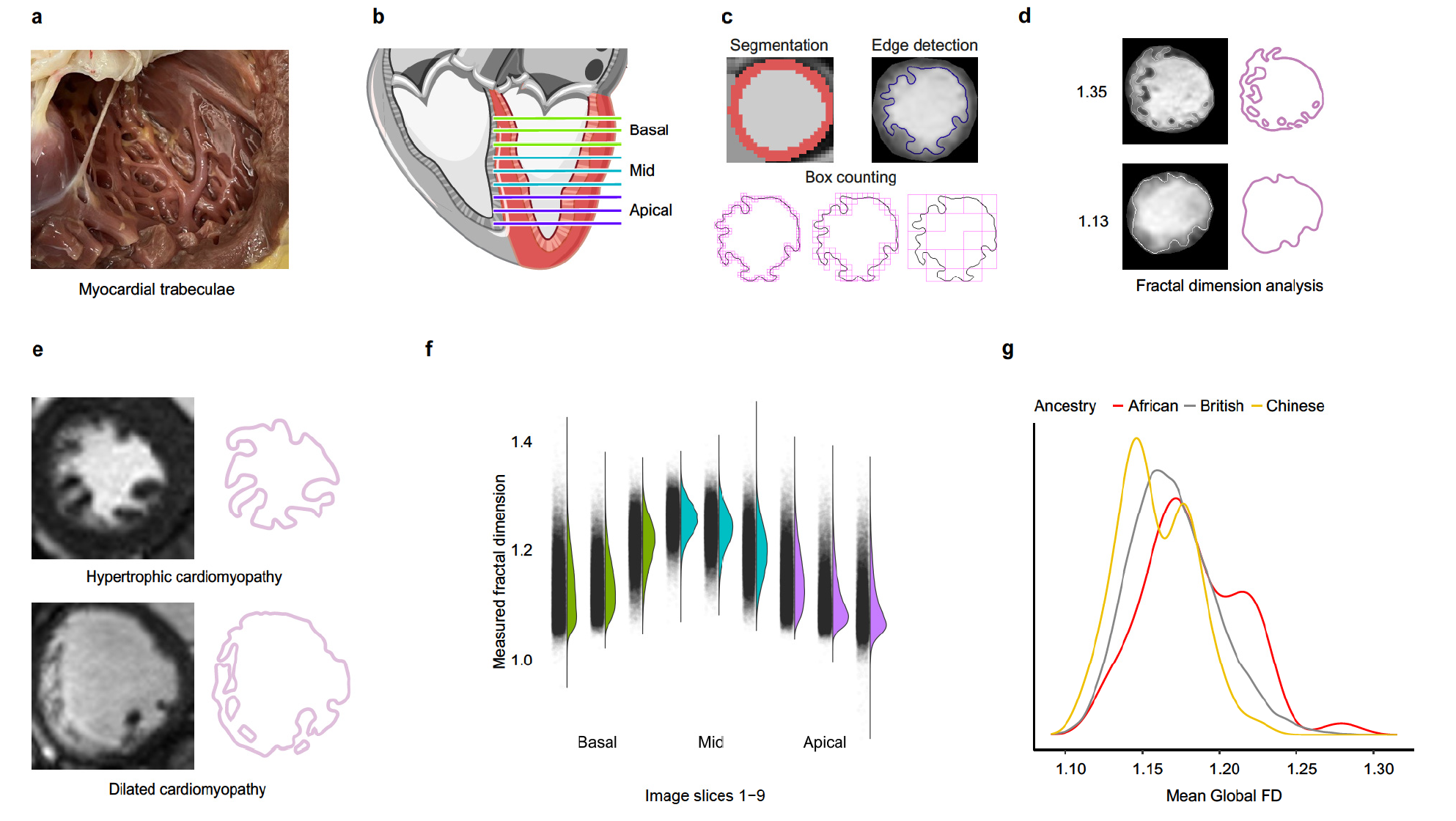
Genetic and phenotypic architecture of human myocardial trabeculation
Kathryn A. McGurk, Mengyun Qiao, et al.
Nature Cardiovascular Research 3, 1503–1515 (2024)
- Investigated genetic factors influencing myocardial trabeculation patterns.
- Identified novel phenotypic correlations linked to cardiac health indicators.
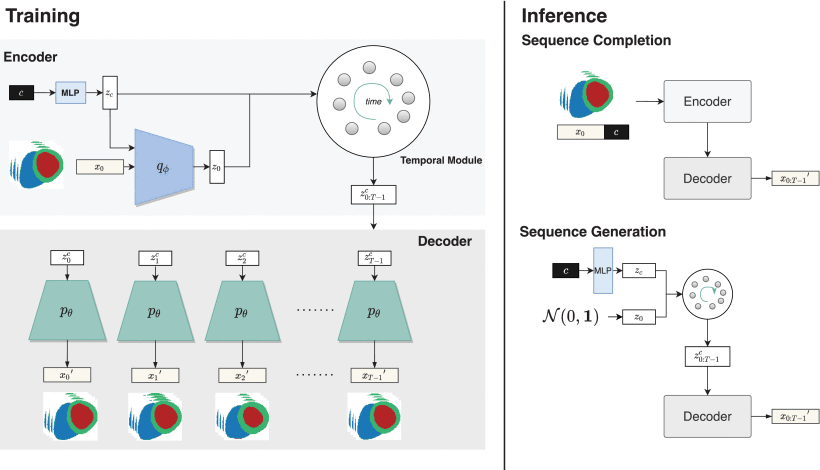
CHeart: A Conditional Spatio-Temporal Generative Model for Cardiac Anatomy
Mengyun Qiao, Shuo Wang, Huaqi Qiu, Antonio de Marvao, Declan P. O’Regan, Daniel Rueckert, Wenjia Bai
- Introduced a conditional generative model to capture spatio-temporal variations in cardiac anatomy.
- Achieved significant improvements in cardiac disease prediction over existing methods.
More Recent Papers
MIDL 2026 ShortCRAgents for Disease Modelling via Multi-Agent Critique and Refinement, Kelly Yu, Zuoou Li, Paul Matthews, Wenjia Bai, Bernhard Kainz, Mengyun QiaoarXiv 2026Learning a dynamic four-chamber shape model of the human heart for 95,695 UK Biobank participants, Qiang Ma, Qingjie Meng, Yicheng Wu, Shuo Wang, Mengyun Qiao, Steven Niederer, Declan P. O’Regan, Paul M. Matthews, Wenjia BaiMICCAI 2025Mesh4D: A Motion-Aware Multi-View Variational Autoencoder for 3D+t Mesh Reconstruction, Mengyun Qiao*, Jin Zheng*, Weitong Zhang, Qiang Ma, Liu Li, Bernhard Kainz, Declan P. O’Regan, Paul M. Matthews, Steven Niederer, Wenjia Bai
Funding
- 2026 DAAD Postdoc-NeT-AI Short-Term Research Scholarship: research stay at FAU Erlangen-Nürnberg.
- 2026-2027 UCL–Fudan Strategic Partner Fund (Principal Investigator).
- 2025 Imperial College Research Fellowship (Principal Investigator): awarded; declined upon accepting a Lectureship at UCL.
- 2024-2025 Dame Julia Higgins Postdoc Collaborative Research Fund (Principal Investigator): Multi-Modality Digital Twin for Personalised Cardiac Diagnostics.
- 2024-2025 Dame Julia Higgins Postdoc Collaborative Research Fund (Co-Investigator): Disease Clusters in People with Metabolic-Dysfunction Associated Steatotic Disease and Multimorbidity.
- 2024 DeepMind UROP (Principal Investigator): AI-Heart Lifespan: Integrating Cardiac Imaging and Clinical Factors to Predict Heart Longevity.
- 2023-2024 Dame Julia Higgins Postdoc Collaborative Research Fund (Co-Investigator): Wearable Urine Volume Measuring Device for Bladder Function Monitoring.
Honors and Awards
- 2022 Best Reproducible Paper Award, MICCAI SASHIMI Workshop
- 2022 Excellent Graduate of Fudan University; Best Thesis of the Year
- 2021 National Scholarship
- 2017 Excellent Undergraduate of Fudan University
Academic Service
- Area Chair MICCAI 2026, IEEE EMBC 2024
- Workshop Organiser 2nd Agentic AI for Medicine (AgenticMed) Workshop, MICCAI 2026
- Grant Reviewer DAAD Postdoc-NeT-AI Programme (2026)
- Journal Reviewer IEEE TMI, IEEE TBME, IEEE JBHI, Medical Image Analysis, MELBA, Scientific Reports, ACM Computing Surveys
- Conference Reviewer MICCAI (2022–2025), AAAI
- Organiser Imperial Data Science Summer & Winter Schools (2023–2025)
Invited Talks
- 2026.10 Invited Talk
- 2026.07 From Personalised Cardiac Digital Twins to Agentic Clinical Discovery
- 2026.06 From Models to Discovery: Generative and Agentic AI for Cardiovascular Research
- 2026.06 Beyond Digital Twins: Generative and Agentic Cardiac Modelling for Clinical Discovery
- 2025.10 Medical Foundation Models and Generalist AI for Healthcare
- 2025 Invited Talk
- 2024.12 The Next Era of Healthcare with Generative AI Technology
- 2024.10 Personalised Generative Models for Unveiling Normal Heart Dynamics
- 2024.07 Deep Generative Modelling for Cardiac Anatomy
- 2023.09 Application and Optimization of Generative AI in Medical Multimodal Data
- 2020.05 Breast DCE-MRI Radiomics: A Robust Computer-Aided System Based on Reproducible BI-RADS Features
- 2019.07 Breast Calcification Detection Based on Radiofrequency Signals by Quantitative Ultrasound Multi-Parameter Fusion
- 2018.09 Fully Automated Left Atrium Cavity Segmentation from 3D GE-MRI
Education
-
2017–2022 DPhil in Biomedical Engineering, Fudan University, Shanghai, China
Awarded the best thesis of the year. Developed intelligent diagnostic algorithms for breast cancer using multimodal medical images. Published five peer-reviewed papers and presented at major conferences. -
2021–2022 Joint PhD Research, Imperial College London, BioMedIA Group, Department of Brain Sciences
Conducted collaborative research focusing on advanced machine learning and generative models for medical imaging. -
2017 Visiting Researcher, Leiden University Medical Center, Department of Radiology, The Netherlands
Investigated cardiac motion tracking methods, achieving significant accuracy improvements using deep learning techniques. -
2013–2017 BEng in Electronic Engineering, Fudan University, Shanghai, China
Graduated with high distinction. Developed a breast ultrasound image analysis system to improve diagnostic efficiency. Awarded best undergraduate thesis of the year.
Teaching
University College London
- 2026–27 MECH0107 Data-Driven Methods for Engineers, Module Tutor
- 2025–26 MECH0064 Group Design Project (MSc), Supervisor & Assessor
- 2025–26 MECH0020 Individual Project, Marker & Presentation Panel
- 2025– Year 1 Personal Tutor, Department of Mechanical Engineering
Imperial College London
- 2023–2025 Deep Generative Models, Demonstrator, Data Science Winter School
- 2023–2025 Generative AI and Image Analysis, Instructor, Data Science Summer School
- 2022–2025 Teaching Assistant: Mathematics for Machine Learning, Signal Processing, Medical Imaging Technology
Resources: Machine Learning in Healthcare
A curated reading list on applying modern machine learning to real-world healthcare problems, covering foundational concepts, practical tools, and ethical considerations in deploying AI in clinical settings.
Topics Covered
- Introduction to Machine Learning
- Data Preprocessing in Healthcare
- Supervised and Unsupervised Learning
- Deep Learning for Medical Imaging
- Natural Language Processing for Clinical Text
- Model Evaluation and Validation
- Ethical and Regulatory Issues in Healthcare AI
Recommended Resources
Books
- Machine Learning Yearning by Andrew Ng (free online book)
- Deep Medicine: How Artificial Intelligence Can Make Healthcare Human Again by Eric Topol
- Introduction to Machine Learning with Python by Andreas C. Müller & Sarah Guido
Online Courses
- Coursera: AI for Medicine Specialization (by deeplearning.ai)
- edX: Machine Learning for Healthcare (by HarvardX)
- Stanford CS229: Machine Learning
Tutorials & Datasets
Papers & Reviews
Feel free to reach out if you have questions or want to discuss project ideas!